
Insights
How Do You Make US Company Papers Valid Abroad?
Leiros ConsultingAugust 6, 20265 min read
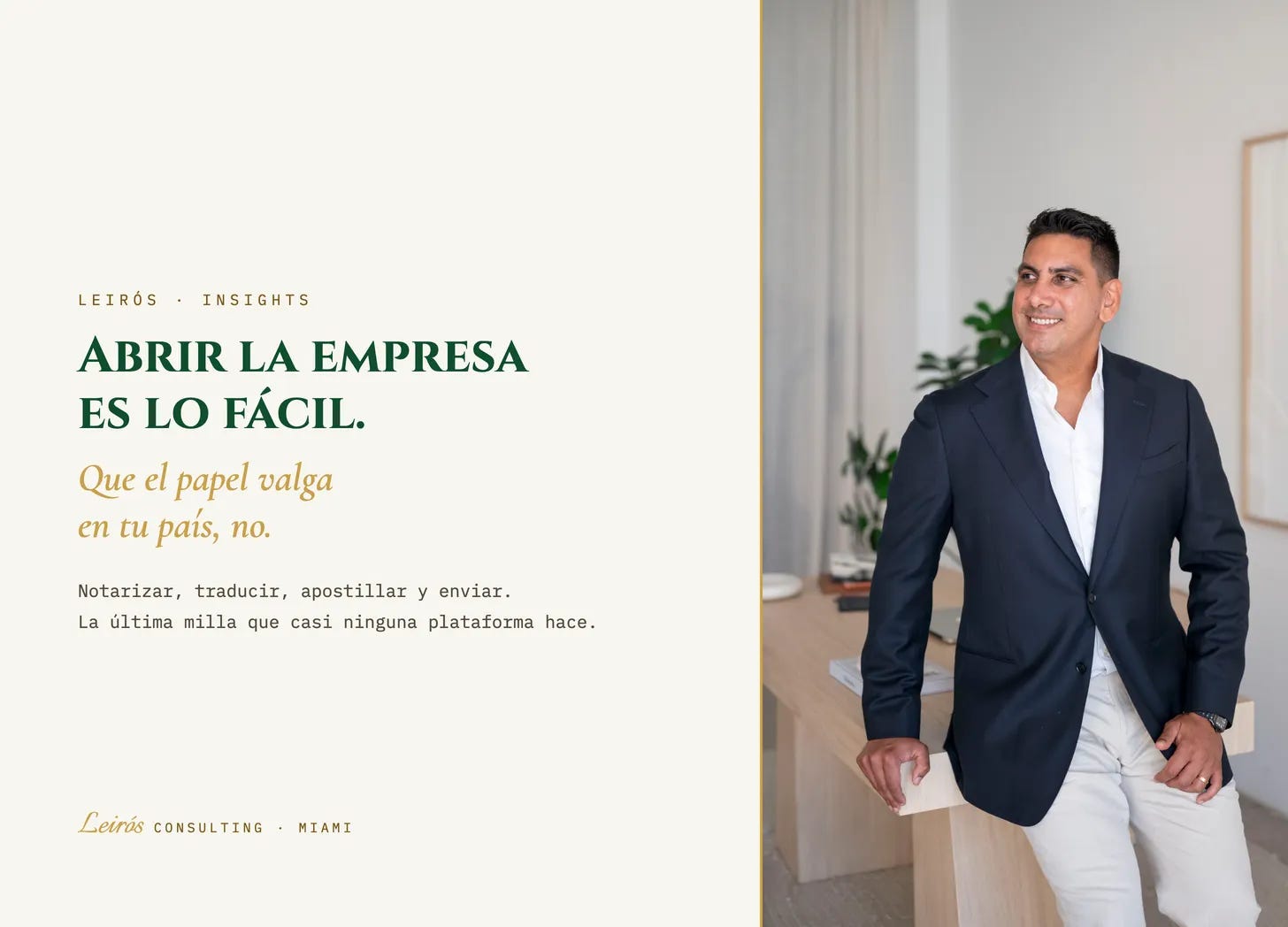
Did you pay an online platform to open your company in the United States, and get left with the paperwork half done?
If you did, you did nothing strange. Forming an LLC takes a day now: you open a website, fill in a form, pay, and within hours your company is registered in Wyoming, Florida or Delaware. It is fast, it is cheap and it works. That is why a thousand platforms sell it, and why none of them warn you about what comes next.
What you bought stops at the border
Your company exists in one US state registry, and the papers they sent you, the Articles of Incorporation and the Operating Agreement, are American documents. In front of a bank in Miami they hold up. The day you carry them home, a different story starts.
Because the procedure you actually wanted is almost never in the United States. It is back home: opening the local bank account, signing before a notary, registering something, giving your brother power of attorney to sign for you, presenting the company to an agency. And the office in front of you wants a document it can accept: in its own language, with a seal it recognises, and the original in hand. Nothing you bought online has any of that.
The four missing steps, and what each one fixes
Notarize. A US notary public certifies that the signature belongs to the person who claims it, or that a copy is faithful to the original. It is the first link and it carries the rest, because what gets apostilled later is precisely that notary’s authority. Without the first signature the chain never starts.
Translate. The document comes out in English and the filing happens in Spanish. A translation done at home will not do, nor will the one from a cousin who spent two years in Houston. Argentina requires a sworn translator on the public register; Chile and Uruguay require official translation. The office rejects anything else, and that rejection reaches you weeks later.
Apostille the document. This is the Hague Convention seal, and it is what turns an American paper into one your country recognises without going through a consulate. The United States, Argentina, Chile and Uruguay are all parties to the convention, so that single seal replaces the old consular legalisation. Watch what it certifies: an apostille attests that the signature and seal on the document are genuine, never that its content is right.
Ship the original. Many procedures still demand the physical paper, with the raised seal and real ink. A PDF is not accepted, and the document has to travel.
Miss one step and the paper is worthless, and you find out late
The four steps run in that order and each one depends on the last. If the document arrives translated but not apostilled, the office sends it back. If it arrives apostilled but the translation carries the wrong signature, it comes back all the same. And since the rejection never happens the day you file, you learn about it weeks later, once you have booked the appointment, told the bank or promised your partner it was handled. Then you go back to the notary and start again.
That is the real cost of the last mile, and it is measured in the weeks your filing spends frozen.
Three cases from this week
A client formed his company in Wyoming through an online platform. They promised him a lawyer to translate his power of attorney, the document that let him carry out a procedure in Chile. That lawyer never showed up, his procedure froze, and his emails slowly went unanswered. He called us, and we notarized the power of attorney, translated it, apostilled it and shipped it to Chile. The procedure that had been stuck for weeks finally moved.
For another set of clients we formed the company in Florida to be used in Argentina. Most would have called the job done there, but the Articles of Incorporation and the Operating Agreement came out in English, and Argentina files its paperwork in Spanish. We notarized them, translated them and apostilled them, and shipped them ready to file.
And for a third we prepared the proof of income he needed for residency in Uruguay. He had no payslip to show, because his money came from four US properties. His tax return proved they were his and how much they earned him each year, so we prepared the official documents that showed it and shipped the original to Uruguay.
How we handle it, and what is left to you
We take the whole chain: we draft the document, notarize it, arrange the translation with someone your country accepts, apostille it and ship it to your address. You sign once and you receive the original.
And let me be honest with you about the part almost nobody explains. Timing is not entirely ours, because each state apostilles at its own pace and every receiving office has its habits. The second point matters more: since the apostille certifies the signature and not the content, a badly drafted document can arrive perfectly sealed and still fail to do what you needed. That is why the order matters, and why we write the document around the specific procedure before we start stamping it.
If you opened your company in the United States and ended up with a paper nobody at home will accept, tell me which procedure you need to complete and in which country. Reply to this email and we will finish it with you.
Best,
Cristián
Leirós. Your ally for your US business paperwork.
Begin
Put your business on American soil.
Tell us where you are and where you are going. We map the path to a U.S. operation and walk every step with you — no obligation.